ljgeoff: (Default)
There's a really good article explaining the difference between CO2 and methane buildup in the atmosphere: ‘Mass delusion and wishful thinking’: Why everything you think you know about methane is probably wrong.

I remember listening to an interview of, damn, now I can't remember his name but he was a geoscientist who was witty and sarcastic, anyway- when asked about the difference between CO2 and methane said something like - We're speeding toward a brick wall at 80 mph. When you add methane to the equation, we're speeding toward that brick wall at 120 mph. Taking methane out of the picture isn't going to make much of a difference.

The article talks about COP28 and how a lot of people are grabbing on to reducing methane as a useful solution, and why that is wrong.
ljgeoff: (Default)
It's all been too much this year. For everyone and for me, too. Personally, I've been working too many hours and overextending myself financially even beyond that. My Plan is coming together, but so slowly!

But as Mike said, the Earth is a big, complex system, and things happen slowly there, too. Here is some of the things that are happening:

1) A warm pool in the Indo-Pacific Ocean has almost doubled in size, changing global rainfall patterns. Mainly, what they're seeing is that this vast area of warmer-than-usual sea is causing a change in weather patterns, making more rain in some places, and less in others. And of course, we need steady weather to grow food. So this isn't one of those We're All Going To Die! things, but certainly some of us are going to die from starvation. But, you know, more than we have been.


2) 2018 was A difficult year for forests, fields and meadows -- this article reports on Physiological response of Swiss ecosystems to 2018 drought across plant types and elevation, research gathered in the summer of 2018, showing overall less development of foliage, and increased plant respiration. "This means that while these systems absorbed more CO2 from the atmosphere, they also released more CO2 back into it." Which is something that's been proven over and over, so nothing really new. The paper also talks about stressed out spruce, compared to less stressed out beech. So, changes of course in what is going to grow where. I would assume that the research gathered here would be easily extrapolated to other forests, fields, and meadow areas.

3) Behold the Sentinel-6 Michael Freilich!
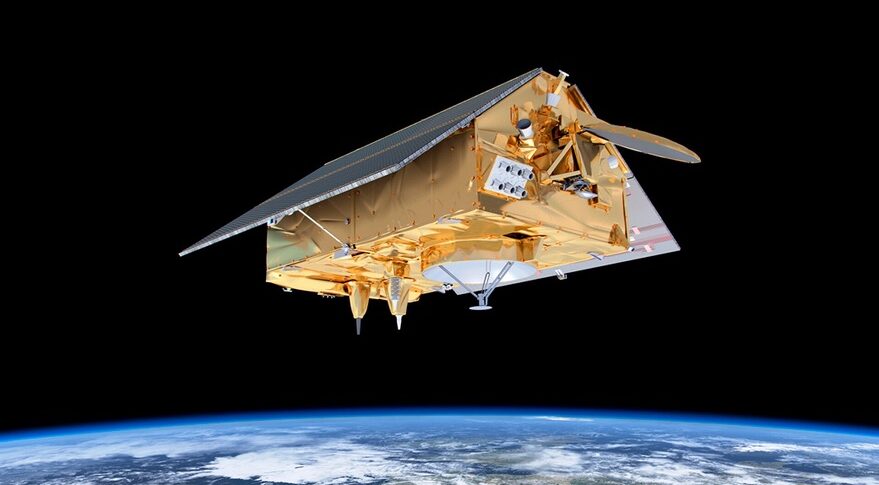


This sweetheart was successfully launched Nov. 21: "Sentinel-6 Michael Freilich is the first of two satellites jointly developed by a group of agencies in the United States and Europe, including NASA, NOAA, the European Space Agency, Eumetsat and the European Commission, to provide precise measurements of rising sea levels." Will having stone-cold scientific proof from satellite data make any difference? No, I don't think it will. Or, rather, it hasn't so far. But Mikey is a pretty little thing, and people have worked their hearts out to have it up there above us, so love to them.

BTW, yeah, the oceans are rising about twice as fast as they did 20 years ago. But no one is going to suddenly drown unless there's a hurricane, and then what do you expect? Sheesh! Hey, remember Mexico Beach, Florida, wiped off the face of the earth in Hurricane Michael? A recent review of the place on Trip Advisor says "Beautiful beach without the crowd! Loved the seclusion of this beach. My family and I were able to set up and enjoy social distancing to the fullest. We did not have anyone near us for as far as we could see down the beach. Nice & clean beach."

4) Methane is seeping from all our very cold places -- the Laptev underwater slope is destabilizing, giant holes continue to appear in the Siberian tundra,
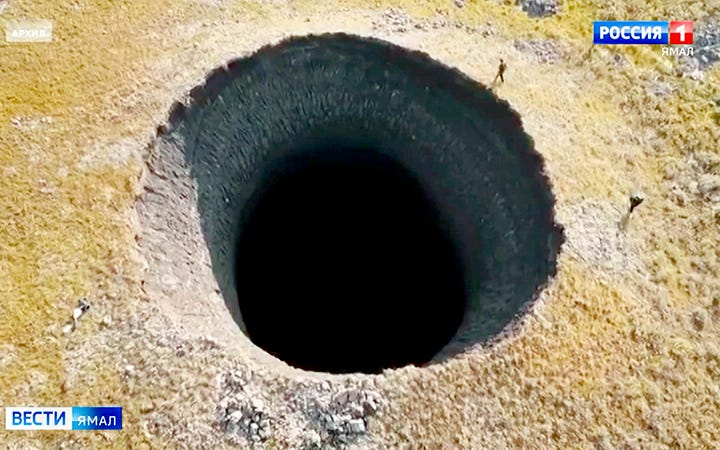

and now the first active leak of methane from the sea floor in Antarctica has been revealed by scientists". But really, whenever I get crazy over methane, I remember what Richard Alley said when I went to see him talk, "The difference between methane and CO2 is hitting a wall at 100 mph or hitting a wall at 60 mph. The 60 mph will do the job."

But with all of this... I have to hope. I have to continue with our Plans. I have to stop being relaxed with my money and funnel all of our resources to the only thing I can imagine has a slim chance of saving some of us. It's pretty nuts, and most of the time I'm just sitting her talking myself into the idea that it might be worth the effort.
ljgeoff: (Default)
In the summer of 2014, a group of over 80 scientists from several countries (sorry, can't find a list) sailed on the Swedish ice-breaker Odin to study the arctic ocean, Natalia Shakhova of the University of Alaska in Fairbanks and Igor Semiletov from the Russian Academy of Science. Shakhova and Semiletov have been studying the arctic for over 20 years and were back to look at the methane plumes coming from the East Siberian shelf.

They found OMG amounts of methane spewing into the atmosphere.

Once you get past that, here's the interesting thing: Gavin Schmidt, NASA director of GISS and Principal Investigator for the GISS ModelE Earth System Mode and blogger at Real Climateis very dismissive of Shakhova and Semiletov's work.

Then, last September, the Royal Society held a very prestigious meeting in which Shakova and Semiletov where conspicuously absent:
The event, held a fortnight ago, is still causing controversy beyond the negative tweeting by NASA Goddard Director, Dr Gavin Schmidt. Schmidt aimed his presentation at discrediting the Russian’s work, using theoretical models, without expertise in methane, or credible data. The end result is that the Russian team have composed a letter to Royal Society President, Sir Paul Nurse, asking for an opportunity to present their findings, including contributions from over 30 scientists working in the region for over 20 years.


Shakova and Semiletov and more that 30 other scientists fired off a letter to Royal Society President Sir Paul Nurse: (excerpt)
To date, we are the only scientists to have long-term observational data on methane in the ESAS. Despite peculiarities in regulation that limit access of foreign scientists to the Russian Exclusive Economic Zone, where the ESAS is located, over the years we have welcomed scientists from Sweden, the USA, The Netherlands, the UK, and other countries to work alongside us. A large international expedition performed in 2008 (ISSS-2008) was recognized as the best biogeochemical study of the IPY (2007-2008). The knowledge and experience we accumulated throughout these years of work laid the basis for an extensive Russian-Swedish expedition onboard I/B ODEN (SWERUS-3) that allowed > 80 scientists from all over the world to collect more data from this unique area. The expedition was successfully concluded just a few days ago.

To our dismay, we were not invited to present our data at the Royal Society meeting. Furthermore, this week we discovered, via a twitter Storify summary (circulated by Dr. Brandon), that Dr. G. Schmidt was instead invited to discuss the methane issue and explicitly attacked our work using the model of another scholar, whose modelling effort is based on theoretical, untested assumptions having nothing to do with observations in the ESAS. While Dr. Schmidt has expertise in climate modelling, he is an expert neither on methane, nor on this region of the Arctic. Both scientists therefore have no observational knowledge on methane and associated processes in this area. Let us recall that your motto “Nullus in verba” was chosen by the founders of the Royal Society to express their resistance to the domination of authority; the principle so expressed requires all claims to be supported by facts that have been established by experiment. In our opinion, not only the words but also the actions of the organizers deliberately betrayed the principles of the Royal Society as expressed by the words “Nullus in verba”.
complete letter is here.

I think that Schmidt, and Hanson as well, have made the decision or been convinced that policy makers and the public are best kept in the dark about what's happening with methane. Because if policy makers and the public knew what was happening with methane, they'd just give up. As one anonymous scientists put it, the projections look "not as bad as Waterworld by worse than Mad Max."

This is so repulsive to me. It reminds me of a decision that I experienced in South Dakota, where a family decided to not tell their parent that she had terminal cancer with less than a few months to live. I just... ffs.

Profile

ljgeoff: (Default)
ljgeoff

January 2026

S M T W T F S
     1 23
45678910
11121314151617
18192021222324
25262728293031

Syndicate

RSS Atom

Most Popular Tags

Style Credit

Expand Cut Tags

No cut tags